Insight · October 22, 2026
Small models,
big enough.
NVIDIA Research says small language models are the future of agentic AI. The logic is hard to fault once you see what an agent actually does all day.
01 · The short answer
Small enough to run where the work is.
A small language model is a language model small enough to run on a laptop, a phone, or a single consumer GPU. Its parameters number from a few million to a few billion, not the hundreds of billions of a frontier model. It trades broad knowledge for speed, low cost, and running close to the work.
That is the whole idea. A frontier model knows almost everything and bills you accordingly. A small model knows less, answers faster, costs little, and can live on the device in your hand. For a narrow job, less is not a compromise. It is the right tool.
02 · Why the argument landed
An agent does narrow work, over and over.
In June 2025, a team from NVIDIA Research and Georgia Tech, led by Peter Belcak, published a position paper with a blunt title: small language models are the future of agentic AI. Their claim, in the paper's own words, is that small models are “sufficiently powerful, inherently more suitable, and necessarily more economical for many invocations in agentic systems.”
The reasoning starts with what an agent is. An agent does not hold one long, open conversation. It takes a goal and breaks it into many small steps. Read a field. Pick a tool. Format a result. Check a value against a rule. Most of those steps are narrow and repeated, and a small model handles them well.
A frontier model can do each step too. It is also overqualified for nearly all of them, and you pay frontier prices every single time it answers. The paper's point is that paying for general intelligence on work that does not need it is a habit, not a requirement.
The one line to keep
“The right question was never how big a model you can afford. It is how small a model can do the job.”
03 · What counts as small
A working line, and the models that sit under it.
There is no standards body for the word small. The common 2026 convention puts a small model under 10 billion parameters, often in the 1 to 7 billion range, small enough to run on consumer hardware without a cloud API. The boundary is fuzzy on purpose. A model that fits on a laptop today would have filled a server two years ago.
These are not toy models. Every major lab now ships a small tier built for exactly this work.
01
Microsoft Phi
Built to reason well above its weight on narrow tasks.
near 4 billion parameters in its smallest instruct variant
02
Google Gemma 3
The smallest variants fit on a phone and still take long inputs.
270 million to 27 billion across the family
03
Meta Llama 3.2
Shipped for the device in your hand rather than the data center.
1 billion and 3 billion
04
Alibaba Qwen3
Tool calling is built in, which is what an agent needs.
small dense models at 0.6, 1.7, 4 and 8 billion
05
Hugging Face SmolLM3
Open weights and open training, with tool calling supported.
3 billion, fully open
04 · One model is the wrong default
Not every call is the same size.
Most agents today route every step to one large model, because it is simple and it works. The paper calls for the opposite: a heterogeneous system, meaning an agent that invokes more than one model and sends each call to the smallest one that can handle it.
Think about the steps again. Deciding the plan for a hard, open request is real reasoning, and the big model earns its cost there. Pulling a date out of an email, choosing between three tools, or turning a result into clean JSON is not. Those are the calls a small specialist answers in a fraction of the time for a fraction of the price.
When an agent runs thousands of steps a day, the mix is where the cost lives. Sending the narrow work to a small model is not a downgrade. It is matching the tool to the task.
05 · How much of the work is actually narrow
Most of an agent's calls do not need the big model.
The paper does more than assert this. It takes real agents and estimates, step by step, how many of their model calls actually needed a large model and how many a specialized small model could have handled.
In MetaGPT, a coding agent, the estimate is that roughly 60 percent of the calls could be handled reliably by appropriately specialized small models. In Cradle, an agent that controls a computer screen, the estimate rises to about 70 percent. The rest, the genuinely open or hard calls, stay with the large model.
Read those numbers with care. This is a position paper, and these are estimates, not a measured benchmark. The point is not the exact percentage. It is the shape: in real agents, the majority of the work is narrow enough that a small model is enough.
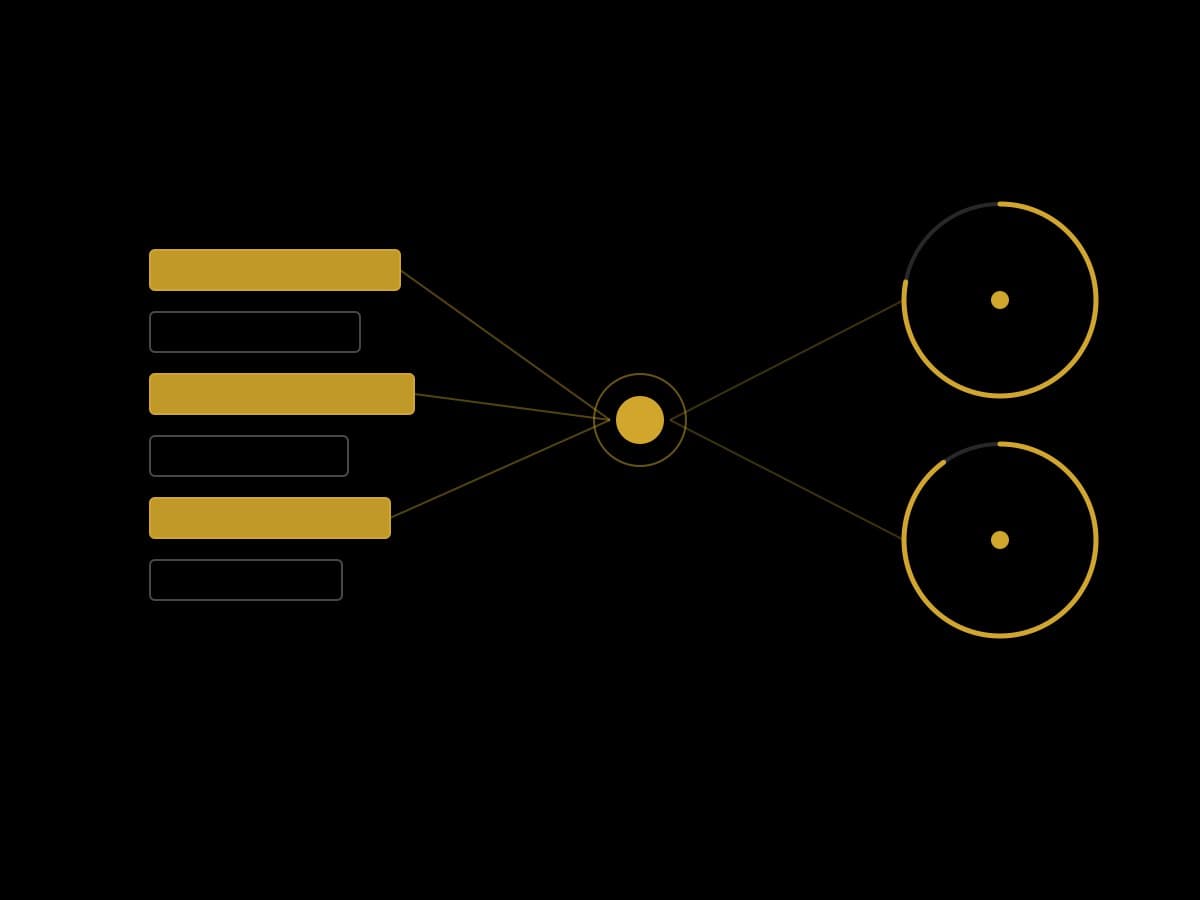
large generalist   plan the hard, open request   ~30 to 40%
small specialist   read a field, pick a tool     ~60 to 70%
                   format a result, check a rule

route each call to the smallest model that holds the bar.
Estimated split from the paper's agent case studies
06 · What the setup looks like
A generalist to plan, specialists to do.
The practical shape is a mix. Keep a strong generalist for the calls that need broad reasoning, long novel context, or open conversation. Hand the narrow, repeated calls to small models tuned for them. A router in the middle decides which call goes where.
The small specialists are where you earn the gains. A model in the single billions can be taught a narrow job once and then run it cheaply forever. If you know when to fine tune a model, a small one is where it pays off fastest, because you are shaping behavior on a task you can describe, not trying to add knowledge the model never had.
This is also why small models suit the way an agent actually works. An agent is a loop of many small, bounded decisions. Bounded decisions are exactly what a small, fast, cheap model is good at.
07 · When to keep the big model
Small is not always enough, and that is fine.
This is not an argument to throw out large models. Broad reasoning across a long, novel problem, open conversation with a person, and the hardest planning steps are still where a frontier model is worth every token. The paper does not dispute that. It argues against using the big model for everything by default.
The line between the two is fuzzy, and it moves. A task that needs a large model this year may fit a small one next year as the small tier improves. The discipline is to check, not to assume. Measure where a small model holds the bar you set, and keep the large model only where it does not.
That is the real shift. Not small instead of large, but the right size for each call, chosen on evidence rather than habit.
Closing
For most of the work, small was always enough.
Look at one agent you run. Count how many of its calls are narrow, repeated steps and how many are genuinely hard. Move the narrow ones to a small model and watch the bill, and the latency, fall without the quality following them down.

Written by · October 22, 2026
Donny Smith · ECD, Founder, Bttr.
Over the past 15 years, he has led creative teams and contributed to products used by millions of people worldwide, working with companies including Apple, Opendoor, JP Morgan, GE Aerospace, Pepsi, and Alterra Mountain Company.
LinkedInSources, facts current as of October 2026 · arXiv · Small Language Models are the Future of Agentic AI, Belcak et al., NVIDIA Research · June 2025 · IBM · What Are Small Language Models · 2025 · Microsoft Azure · What Are Small Language Models · 2025 · Machine Learning Mastery · Introduction to Small Language Models · 2026
Share this perspective
More insights
Adjacent perspectives.

Bttr. Field Brief
The brief Bttr. writes for senior buyers.
Monthly. One signal worth your time on Brand Operating Systems, AI search visibility, and the infrastructure buildout. No filler.