Insight · June 18, 2026
Designing around
the machine.
Midjourney shipped a body scanner. The device was the easy part.
01 · What shipped
A working machine, not a concept.
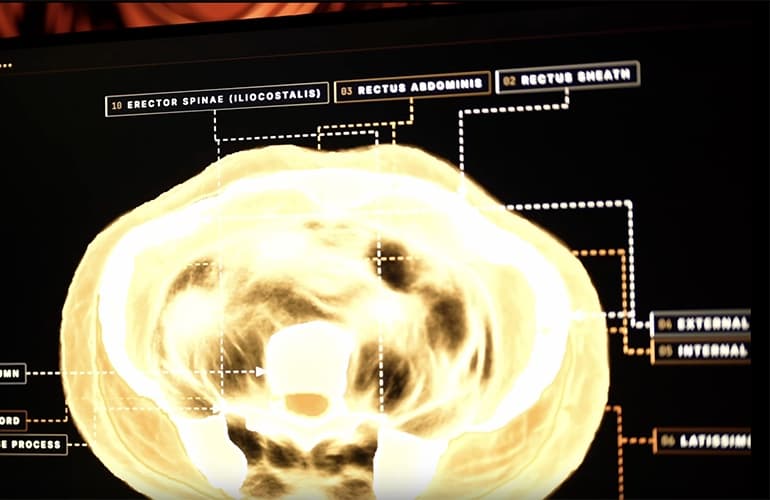
You step into a shallow pool of warm water. A ring of half a million sensors sends sound through your body from every angle. About a minute later you have a 3D map of your insides down to a fraction of a millimeter. No radiation. No tube. No lying perfectly still.
It is ultrasound, carrying the resolution of an MRI. A full body scan in 60 seconds instead of an hour in a tube. They are calling it the Midjourney Scanner, and yes, it is the same Midjourney that makes the images.
60s
Full body scan
100x
Faster than an MRI
10x
Cheaper
9
People who built it
02 · The category they walked into
A market that was supposed to be impossible to enter.
Medical imaging belongs to a handful of giants. The moat was supposed to be the physics, the capital, the regulators, the decades of installed base and service contracts. It is the kind of category a sane founder is told to never touch.
A team of nine, at a company known for generating pictures, shipped a working machine into it anyway. Not a slide. Not a render. A device you can stand inside.
The reframe
“They did not build a hospital machine. They built a spa. The scan is a side effect of a place you would want to be anyway.”
03 · The move
They redesigned the room, not the device.
The incumbents spent decades optimizing the machine. Stronger magnets, tighter tolerances, faster reconstruction. Every gain lived inside the same anxious experience. A cold tube. A loud room. A reason to be afraid before you arrive.
Midjourney left the device alone and rebuilt everything around it. Warm water instead of a tube. A place you would choose to visit instead of a place you are sent. The scan stopped being the point and became the thing that happens while you relax.
That is the whole story compressed into one decision. The spec sheet was never the product. The experience was, and the team that owns the experience owns the category.
04 · Why the image company
It is the same problem wearing a different coat.
Generating an image and reconstructing a body are the same discipline underneath. Both take incomplete, noisy signal and resolve it into a coherent picture. Midjourney spent years getting very good at exactly that, then pointed the competence at sound waves instead of pixels.
This is not a company doing something random. It is a company following its core skill into an adjacent market that nobody thought it was allowed to enter. The adjacency was always there. Most teams just never look up from the category they are told they belong to.
05 · Nine people
The headcount a hard category now requires.
A decade ago a project like this needed hundreds of people and a war chest. The number that should stop you is nine. The tooling collapsed the team you need to attempt something this ambitious, and a small group with sharp taste now reaches what used to require an institution.
This is the part worth internalizing. Small teams are not a constraint to apologize for. With the right leverage they are the advantage. Fewer people, more taste, faster decisions, and nobody to slow the one idea that matters.
Closing
The machine was the easy part.
The hard part was everything around it. The water, the room, the reason to come back. That is the work, and it is the work most teams leave undone.

Written by · June 18, 2026
Donny Smith · ECD, Founder, Bttr.
Over the past 15 years, he has led creative teams and contributed to products used by millions of people worldwide, working with companies including Apple, Opendoor, JP Morgan, GE Aerospace, Pepsi, and Alterra Mountain Company.
LinkedInImagery and figures · Midjourney Medical · A New Era of Midjourney →
Share this perspective
More insights