Insight · August 8, 2026
Rank in the
answer.
Half of Google searches now open with a written answer instead of ten blue links. Ranking first no longer means you are in it.
01 · The shift
The links did not disappear. They stopped being the first thing people read.
Google introduced AI Overviews at its developer conference in May 2024, the successor to the experiment it had called Search Generative Experience. By July 2026, Similarweb data put them in roughly 43 percent of United States searches, up from about 15 percent a year earlier. BrightEdge measured closer to half. Either way the shape is the same. For a large and growing share of queries, the first thing a person reads is a synthesized answer that Google wrote, with a few sources cited beside it.
That answer is not a ranking. It is a summary built from several pages at once. Your page can rank first and never appear in it. Another page can sit on the second screen of results and get quoted at the top. The question that used to decide your traffic, where do I rank, now sits underneath a second question that decides more, am I in the answer.
02 · Why position one stopped being enough
Being cited and being ranked are drifting apart.
Ahrefs studied this directly. Looking at 863,000 keywords and four million URLs, it found the correlation between a top ten organic ranking and an AI Overview citation had fallen from 76 percent to 38 percent. Ranking still helps. It is no longer the whole story. Close to half of the pages cited in AI Overviews now come from outside the top ten results for the same query.
The gap widens when you compare Google's two AI surfaces. AI Overviews sit above the blue links. AI Mode is the full conversational search experience. Ahrefs compared 540,000 query pairs across the two and found they cite the same URLs only 13.7 percent of the time, even though they reach a semantically similar answer 86 percent of the time. Same question, nearly the same conclusion, almost entirely different sources. Being visible in one does not carry you into the other.
The one line to keep
“You are no longer ranking a page. You are trying to be one of the sources an answer is built from.”
03 · How the answer gets built
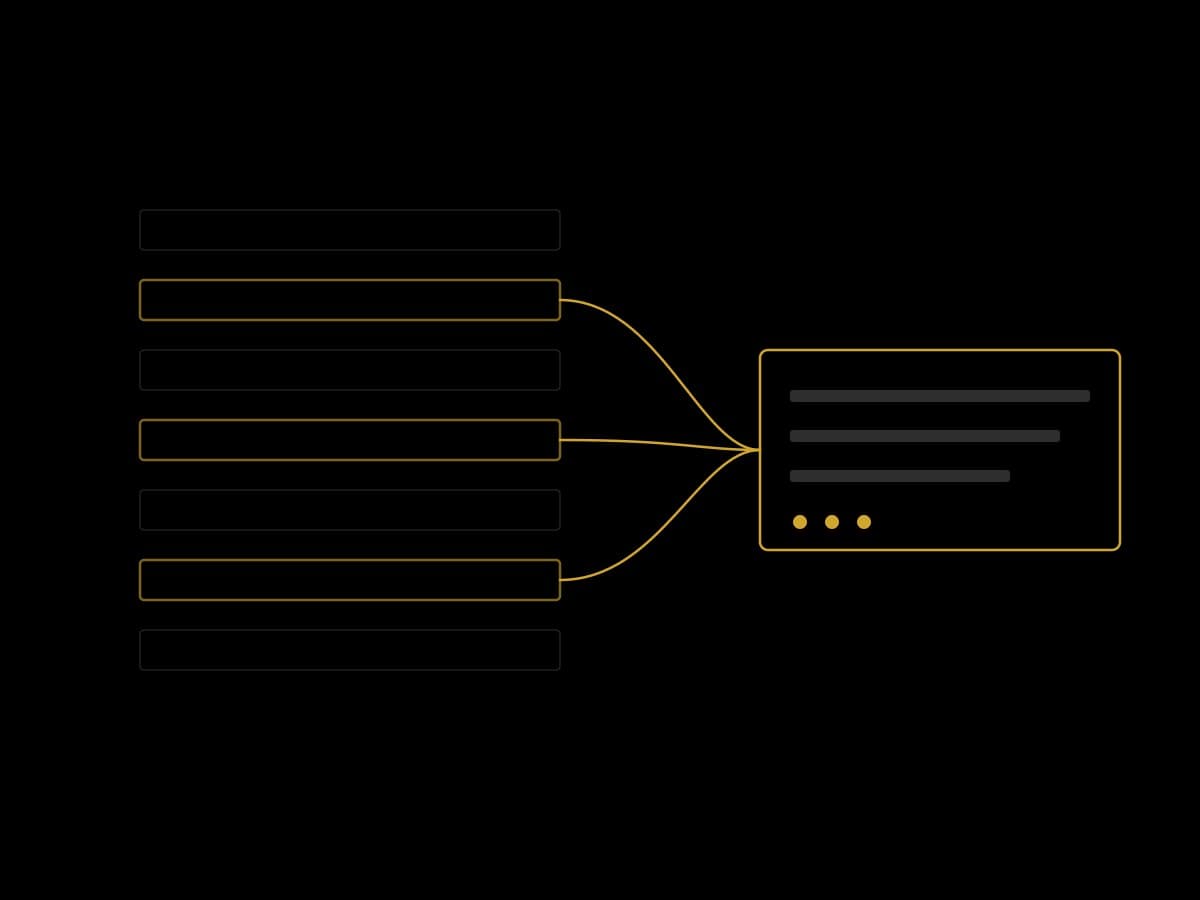
One query becomes many. That is the whole mechanism.
Google calls the technique “query fan out.” It is why a page can rank low on the broad term and still be quoted. It won a smaller question the top of the page never answered.
01
Split
Your one question is broken into subtopics. A search for a laptop becomes separate searches for battery, weight, price, and repair.
02
Search in parallel
Each subquestion runs at once against the Search index, the Knowledge Graph, and live data, not a single lookup.
03
Ground
A version of Gemini tuned for search reads the retrieved pages and writes the answer from them, rather than from memory.
04
Cite
The answer names the pages it leaned on. Almost every AI Mode response carries at least one citation.
05
Synthesize
The subanswers are woven into one response. You are cited for the subquestion you answered best, not for the headline term.
04 · What Google actually told you to do
There is no separate discipline. Google says the answer is still search.
On May 15, 2026, Google published its first official guidance on this, a document on optimizing a site for generative AI features, announced by John Mueller and filed under a new section it named Generative AI fundamentals. The central message is blunt. The terms people invented for this, GEO and AEO, describe the same work as SEO. Generative answers are built on the same ranking and quality systems as the rest of Search.
Google was equally clear about what does not help. You do not need an llms.txt file. You do not need special schema, because a hidden markup that unlocks inclusion does not exist. You do not need to chunk your content or rewrite it for machines. What Google says earns a place is unglamorous. Content that is not a commodity, carrying a point of view, firsthand experience, or original evidence. Clear structure. Strong images and video. A page that loads and can be read without obstruction. Accurate business and product data where it applies.
05 · What this looks like in practice
Win the subquestions, not the slogan.
Take a company that sells project management software. The old target was the phrase project management software, a single brutal ranking race. Fan out changes the target. The answer to that phrase is now assembled from pages that each nailed a narrower question. How does it handle recurring tasks. What does it cost for a team of fifty. Can it import from a competitor. Where is customer data stored.
The page that gets cited is the one that answered a single one of those cleanly, with a real example and a number that checks out, in a section a machine can lift without stripping the meaning. So the work is no longer one page fighting for one term. It is a set of pages, each the best public answer to a real question a buyer asks. That is a content strategy, not a markup trick, and it is exactly what Google described.
Term you want to win: "project management software"

Subquestions the answer is actually built from:
· recurring tasks and automation
· pricing for a team of fifty
· importing from another tool
· where customer data is stored

Own the clearest public answer to each.
You get cited on the parts, not the whole.
One term · many answers · cited on the parts
06 · What earns a citation
The same things that earned trust before, measured more strictly.
Strip away the mechanics and the requirements are familiar. Say something a hundred other pages have not already said. Show that you know it from doing it, not from summarizing others. Make the claim specific, a number, a date, a named example, so the model can quote it without guessing. Keep the page clean enough that a reader, human or machine, reaches the point without a wall in the way.
The reason this feels new is that the bar moved. When ten links shared the page, a thin article could still catch a click on reputation alone. In an answer that cites three or four sources, thin does not get named at all. The reward for being genuinely the best source went up. The consolation prize for being merely adequate went to zero.
07 · The trap to avoid
Do not build for the machine. It tends to punish you for it.
The moment a shift like this lands, a market of shortcuts appears. Schema packs that promise citation. Files to place at your root. Services that rewrite your pages into fragments a model will supposedly prefer. Google named these directly and called them unnecessary. Some of the rewrites make pages worse for the people who were the point in the first place.
Chase the citation and you optimize for a system that changes its selection every few months. Build the clearest, most credible answer to a real question and you are positioned for whatever surface renders it next, an Overview today, a different one tomorrow, a competing engine after that. The durable move has not changed. Be the source worth quoting.
For how the other engines make the same call, read how Gemini chooses sources and the wider shift in GEO versus SEO.
Closing
Stop ranking pages. Start being the source.
Pick one question your best customer actually asks. Write the clearest, most specific, most obviously firsthand answer to it on the public web. Do that ten times and you stop worrying about which surface shows the answer, because you are in it.
Google Search Central guidance on generative AI features, May 2026 · Similarweb and BrightEdge AI Overviews coverage data, 2026 · Ahrefs studies of AI Overviews and AI Mode citations, 2026
Share this perspective
More insights
Adjacent perspectives.


Bttr. Field Brief
The brief Bttr. writes for senior buyers.
Monthly. One signal worth your time on Brand Operating Systems, AI search visibility, and the infrastructure buildout. No filler.