Insight · September 20, 2026
A database that
searches by meaning.
Every AI answer grounded in your own data, every agent that remembers, reaches through the same piece of infrastructure. Here is what it is.
01 · The shift
Meaning is the thing you cannot look up.
For fifty years a database found a row by matching it exactly. You asked for the customer named Ortega and it returned the row that said Ortega. That worked because the question and the answer used the same word.
It breaks the moment the match is about meaning. A support article about a refund and a customer asking to get their money back share almost no words. A keyword index sees two unrelated strings. A person sees one question. Closing the gap between those two is the job a vector database exists to do, and retrieval augmented generation made that job standard across 2026.
02 · The problem
A word is a string. Meaning is a number.
A model does not read text the way you do. It turns each piece of text into an embedding, a long list of numbers that places the meaning of that text at a point in space. Two pieces that mean the same thing land near each other, even when they share no words. Refund and get my money back sit close. Refund and quarterly earnings sit far apart.
Once your documents are numbers, the question of which ones are relevant becomes a question of which points sit nearest. That is not something a normal database is built to answer. It matches values. It does not measure distance. More than 80 percent of enterprise data is unstructured, the notes and tickets and transcripts that never fit the exact match model, and that is exactly the data a vector database was built to search.
The one line to keep
“A vector database does not look for the row that matches. It looks for the ones that are close.”
03 · What actually happens inside
Store the meaning, then search by distance.
01
Embed
Every document, image, or record goes through an embedding model and comes out as a vector, a list of numbers that fixes its meaning as a point in space.
02
Store
The database keeps each vector next to the original, so a match can always point back to the real thing it stands for.
03
Index
It builds a structure over the vectors so it can find the near ones without comparing the query to every record it holds.
04
Search
A query is embedded the same way, then the database returns the records whose vectors sit closest, measured by cosine similarity, Euclidean distance, or dot product.
05
Return
The nearest records come back ranked by closeness, and whatever asked the question, a model or a person, gets meaning instead of a keyword.
04 · Close enough, on purpose
The search is approximate, and that is the point.
Finding the true nearest point means comparing the query to every vector you hold. At a few thousand records that is instant. At a few hundred million it is hopeless. So a vector database does not look for the exact nearest neighbor. It looks for the approximate one. Approximate nearest neighbor search trades a sliver of accuracy for orders of magnitude of speed, and for search by meaning that trade is almost always right.
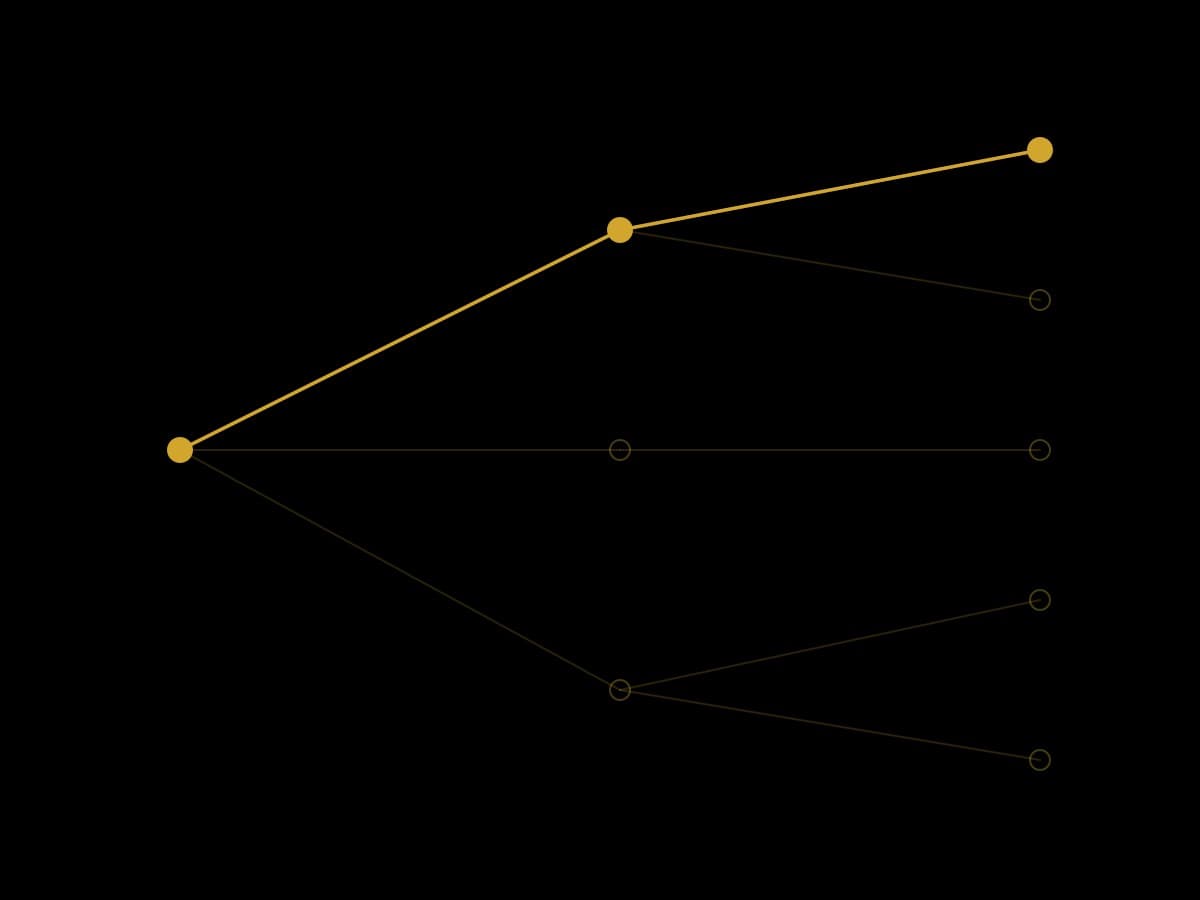
The dominant method is a graph called the hierarchical navigable small world, or HNSW, introduced by Yury Malkov and Dmitry Yashunin in 2016. It builds the vectors into a graph in layers. The top layer holds a few long range links that jump across the whole space. Each layer below adds shorter links and more detail. A search starts at the top, moves quickly toward the right region, then drops down layer by layer to pin the closest points. The result is search that stays fast as the data grows into the billions.
05 · The example that shows why it matters
The same question, grounded in your own data.
Here is where it earns its place. A language model knows only what it was trained on. Ask it about your own policies, your own tickets, your own catalog, and it guesses. Retrieval augmented generation fixes that by putting a lookup in front of the model. The vector database holds your documents as embeddings. A question comes in, gets embedded, and the database returns the handful of passages that sit closest in meaning.
Those passages go into the prompt, and the model answers from them instead of from memory. That is what grounds an answer in fact and keeps it from inventing one. It is also what gives an agent a memory: the same lookup, run against what the agent has already seen, so it can recall instead of repeat.
question   →  embed   →  vector

vector     →  nearest neighbor search   →  matching passages

passages   +  question   →  model   →  answer grounded in your data
A retrieval step · the model answers from what was found, not what it recalls
06 · Choosing one
You may already have one running.
The category looks crowded, and it is, but the choices sort into three shapes. There are purpose built engines, among them Pinecone, Weaviate, Milvus, Qdrant, and Chroma, each built from the ground up for vector search. There are extensions that add vector search to a database you already run, the most common being pgvector, which turns PostgreSQL into a vector store. And there are libraries like Faiss, the vector search toolkit from Meta, which give you the raw search with no database around it.
The honest default for most teams in 2026 is the one they already operate. For a retrieval workload under roughly ten million vectors, pgvector on existing Postgres carries most of the load with no new infrastructure. Cross into tens of millions of vectors, or need hybrid search that blends meaning with keywords and filters, and a purpose built engine like Qdrant or Weaviate starts to pay for itself.
The market reflects the pull. Analysts put the vector database category near 2.49 billion dollars in 2025 and around 3.09 billion in 2026, on a path toward 17.37 billion by 2034. The number that matters more is quieter: agents now issue far more queries than people do, and every one of them is a lookup by meaning.
07 · When not to reach for one
Not every search needs one.
A vector database is not a replacement for the database you have. If your queries are exact, give me the order with this id, show every invoice from March, a relational database is faster, cheaper, and exactly right. Vector search earns its cost only when the question is about meaning and the match is fuzzy.
It also adds moving parts. Embeddings have to be generated, kept in sync when the source changes, and regenerated when you swap the model that made them. An index has to be tuned. And approximate search means the occasional near miss, which is fine for finding related documents and wrong for anything that has to be precise.
The rule is simple. Reach for a vector database when meaning is the query. Keep your existing database for everything else. Most real systems run both, and the skill is knowing which question belongs to which.
Closing
Search stopped being about the words. It is about the meaning.
The unit of search is no longer the word you typed. It is the meaning behind it, stored as a number, found by distance. A vector database is the piece that makes that lookup possible. Once you see it, you see it everywhere: in the answer that cites your own documents, in the assistant that remembers, in the search that finally understands the question.
Sources · Fortune Business Insights, Vector Database Market, 2026 · Zilliz and MongoDB on the hierarchical navigable small world, method introduced by Malkov and Yashunin, 2016 · DataCamp and Firecrawl, Best Vector Databases 2026 · IBM, Vector Databases for RAG · all retrieved September 2026
Share this perspective
More insights
Adjacent perspectives.
Bttr. Field Brief
The brief Bttr. writes for senior buyers.
Monthly. One signal worth your time on Brand Operating Systems, AI search visibility, and the infrastructure buildout. No filler.