Insight · August 16, 2026
The machine
speaks first.
An AI answer describes your brand before a person reaches your site. The model wrote it. Your guidelines never reached the model.
01 · The shift
Something else answers for you now.
A growing share of people meet your brand as a paragraph a model wrote. They ask a chatbot what you do, whether you are any good, how you compare. The answer arrives before they ever open your site.
This is already normal. Capital One Shopping found that 43 percent of United States online shoppers used an AI assistant to research products in the past 90 days. G2 found that about half of business software buyers now begin their research inside an AI chatbot rather than a search engine. The first impression of your brand is increasingly a sentence you did not write.
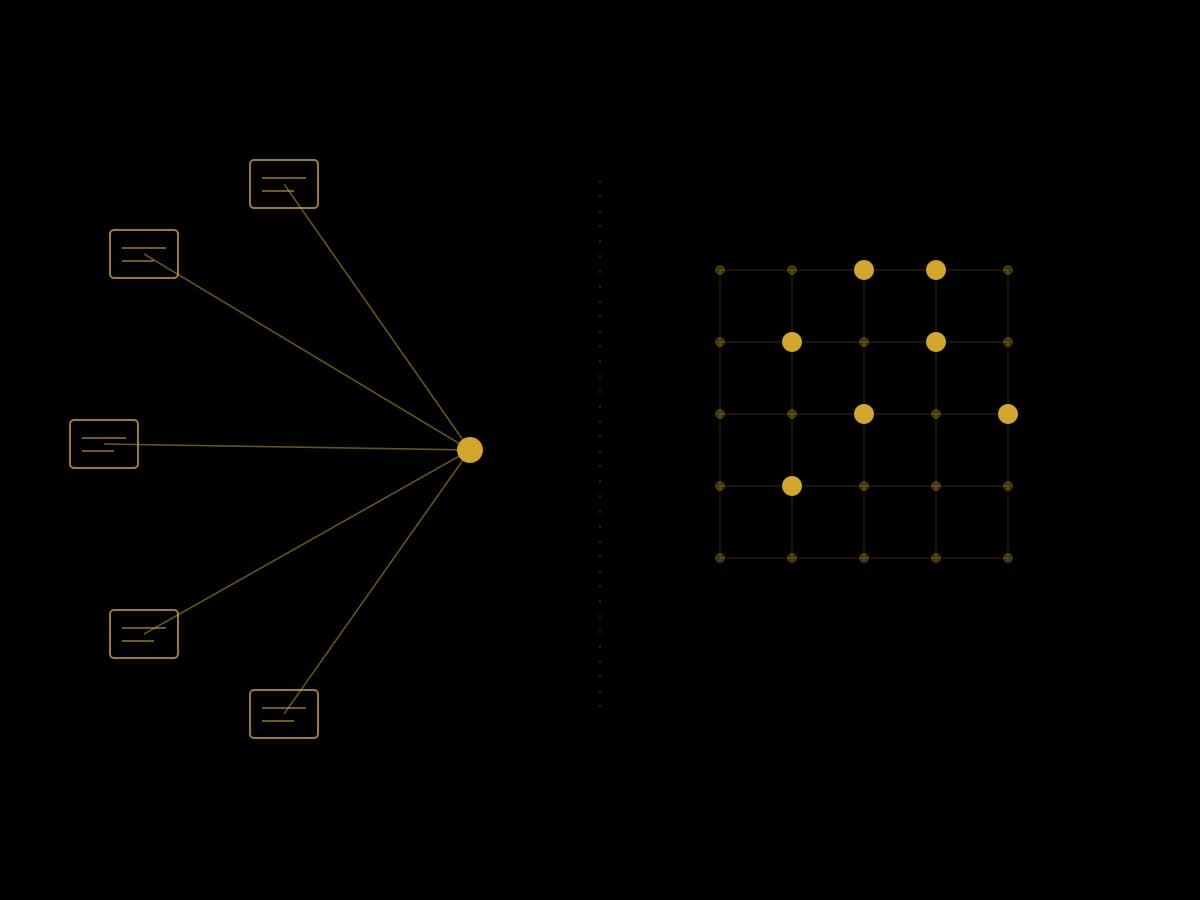
And the model did not compose that sentence from your brand guidelines. It composed it from what it has read about you across the open web, filled in with the average of everything else it has seen.
02 · The problem
Your brand guidelines were written for humans.
A brand book is a document a person reads, absorbs, and applies with judgment. A model does none of that. It cannot open a 60 page PDF, feel the mood board, and infer your voice. Handed nothing structured, it reaches for the most common pattern in its training data.
That default has a shape, and it is the same for everyone. The careful hedging. The tidy list of three. The corporate warmth that reads as no one in particular. Practitioners call the slide toward it tone drift, and it happens on its own as a conversation runs long or a model updates underneath you.
The result is a brand that sounds like every other brand, because it is quite literally the average of them. Nothing you worked to make distinct survives contact with a model that was never told what distinct means for you.
Worse, the effect compounds. The generic output a model produces becomes text on the web, which becomes training data, which pulls the next model further toward the middle. Left alone, the average does not hold steady. It flattens.
The one line to keep
“A model does not read your brand guidelines. It reads the internet’s version of you.”
03 · What an AI ready guide contains
Five parts, expressed as something a model can process.
01
Voice rules
Concrete sentence patterns, not three adjectives. Sentence length, rhythm, the words you use and the words you refuse. A model can follow a rule. It cannot follow a mood.
02
Reference passages
Real writing in your voice the model can pattern match against. Examples do more than instructions, because they show the target instead of describing it.
03
Negative examples
The moves the model must never make. The generic phrases, the hedging, the tone that belongs to every brand and therefore to none. Naming what is wrong prevents the drift toward it.
04
Facts and boundaries
The canonical facts about the company and the claims it must never invent. This is the difference between a model that represents you and a model that makes something up in your name.
05
Distribution
The mentions of you across the open web. This is the part most brand guides forget, and it is the part the model actually reads.
04 · The mention is the signal
What the Ahrefs AI Overview brand visibility study found.
The Ahrefs AI Overview brand visibility study covered 75,000 brands. Branded web mentions correlated 0.664 with visibility in Google AI Overviews. Backlinks, the signal a generation of marketers optimized for, scored 0.218. A follow up covering ChatGPT and Google AI Mode found mentions on YouTube the single strongest predictor at 0.737. What the web says about you is what the model repeats.
Read plainly, that says a model trusts what independent sources say about you far more than the links pointing at you. Mentions teach it who you are. A brand guide that lives only in a shared drive never reaches the model. A brand guide expressed as consistent language, wherever the web talks about you, is the version the model learns.
So the encoding has an inside and an outside. Inside, the rules and examples that steer any model you run directly. Outside, the consistent story across every place the model reads. Both are the brand guide now.
05 · What you actually hand the model
A voice you can read, rewritten as a voice it can run.
The artifact is small and specific. It is not a mood, it is a set of instructions with examples attached, the kind of thing a model can carry into every reply it drafts in your name. The same spec should govern every surface, from a support answer to a generated campaign line, so the brand does not change register the moment it changes channel.
Notice what it is made of. A short list of voice rules. A pair of examples for what to do and what to avoid. A block of facts the model may state and a line it must never cross. That is enough for a model to hold a voice. It is far more than most brands have ever written down.
VOICE
Plain declarative sentences. Short. One idea each.
No hype adjectives. No exclamation marks.

ALWAYS
Lead with the claim, then the reason.
Name the tradeoff instead of hiding it.

NEVER
"Revolutionary", "seamless", "game changing".
Hedging that could belong to any company.

FACTS
Founded and run from the studio. State only what is true.
Never invent a metric, a client, or a date.
A voice spec · rules plus examples plus hard boundaries
06 · Consistency is the whole game
Give the model one version to learn.
A model builds its picture of you by averaging what it finds. If it finds one voice and one set of facts everywhere it looks, the average is that voice. If it finds a different tone on the site than in the press, a different claim in the deck than on the blog, it averages the difference into something blurry.
Consistency is not a style preference here. It is the mechanism. The generic median you are trying to avoid is exactly what a model produces when it has competing versions of you and no reason to prefer one. Remove the competition and the brand sharpens on its own.
Which means the work is less about a single clever prompt and more about discipline across every surface a model can read. The same rules, the same facts, the same voice, in the product, in support, in the writing other people do about you.
07 · What this is not
Not a prompt, and not a rebrand.
This is not writing one clever instruction and calling it done. A voice spec is a living document. Models update, context windows fill, and drift returns. It has to be audited against real output on a schedule, the way you would review any process that runs without you.
It is also not a replacement for brand strategy. It is the encoding of one. If the brand has no clear voice to begin with, there is nothing to write down, and a model will hand you the median because you handed it nothing else. The test is simple. If you cannot state your voice as rules and examples, neither a model nor a new hire can reproduce it.
And it is not only about the models you run. Most of your exposure is in models you will never touch, learning from a web you can only influence by being consistent on it.
Closing
Write the guide the machine can read.
Ask three models to describe your brand today. Read what they say back. The gap between that and what you meant is the size of the guide you have not written yet. Close it in rules, examples, and one consistent story across the web.

Written by · August 16, 2026
Donny Smith · ECD, Founder, Bttr.
Over the past 15 years, he has led creative teams and contributed to products used by millions of people worldwide, working with companies including Apple, Opendoor, JP Morgan, GE Aerospace, Pepsi, and Alterra Mountain Company.
LinkedInAhrefs AI Overview brand visibility study, 75,000 brands, 2026 · Capital One Shopping AI shopping research, 2026 · G2 buyer behavior via Demand Gen Report, 2026
Share this perspective
More insights
Adjacent perspectives.


Bttr. Field Brief
The brief Bttr. writes for senior buyers.
Monthly. One signal worth your time on Brand Operating Systems, AI search visibility, and the infrastructure buildout. No filler.